Why Vanity Metrics Are Killing Your Marketing Budget (And What to Track Instead)
Most SMEs track likes, reach, and followers. These metrics feel great until you look at the P&L. Here are the 6 numbers that actually move your business forward.

Your marketing agency sent you a report last month. It looked great. Reach was up 40%. Impressions crossed 100,000 for the first time. Your Instagram post about the company anniversary got 847 likes.
Then you checked your revenue.
Nothing moved.
This is the vanity metrics trap, and most businesses fall into it at some point. The numbers on your dashboard feel like progress. They look like proof that marketing is working. But if they're not connected to actual sales, you're not measuring your business. You're measuring the platform's health.
There's a useful observation buried in Seth Godin's writing: competitive stats "aren't there to help you. They're there to support the system and the people who run it." He was making the point about word games, but it applies perfectly to marketing dashboards. Instagram shows you reach because reach keeps you posting. Meta shows impressions because impressions justify ad spend. TikTok shows views because views keep creators creating. The metric serves the platform. It may or may not serve you.
Here's how to tell the difference.
What Counts as a Vanity Metric?
A vanity metric is any number that feels good but doesn't reliably predict revenue or business outcomes. It's not entirely useless, but it's so far removed from your actual goal that you can't act on it meaningfully.
The five most common ones:
Followers and page likes. Gratifying when they go up. Meaningless in isolation. An account with 500 engaged followers who actually buy is worth more than 50,000 who scrolled past once.
Post reach and impressions. Your content reached 80,000 people. How many of them wanted what you sell? Reach tells you how far your message traveled, not whether anyone cared.
Website traffic (as a headline number). "Traffic is up 30%" sounds good until you find out most of it bounces in under 8 seconds. Traffic without conversion data is noise.
Video views. On Facebook, a "view" is counted after 3 seconds. On TikTok, it's 1 second. Platforms have very generous definitions of "watching."
Social media engagement (likes, shares, comments). Engagement on organic posts is fine to track. But it's not a business outcome. Your content went viral. Did anyone book an appointment?
These metrics aren't worthless. Reach matters if you're building brand awareness and you've defined what that means for your business. Engagement can correlate with sales if you track it properly. But as the primary measure of whether your marketing is working, they're a distraction.
The 6 Metrics That Actually Matter
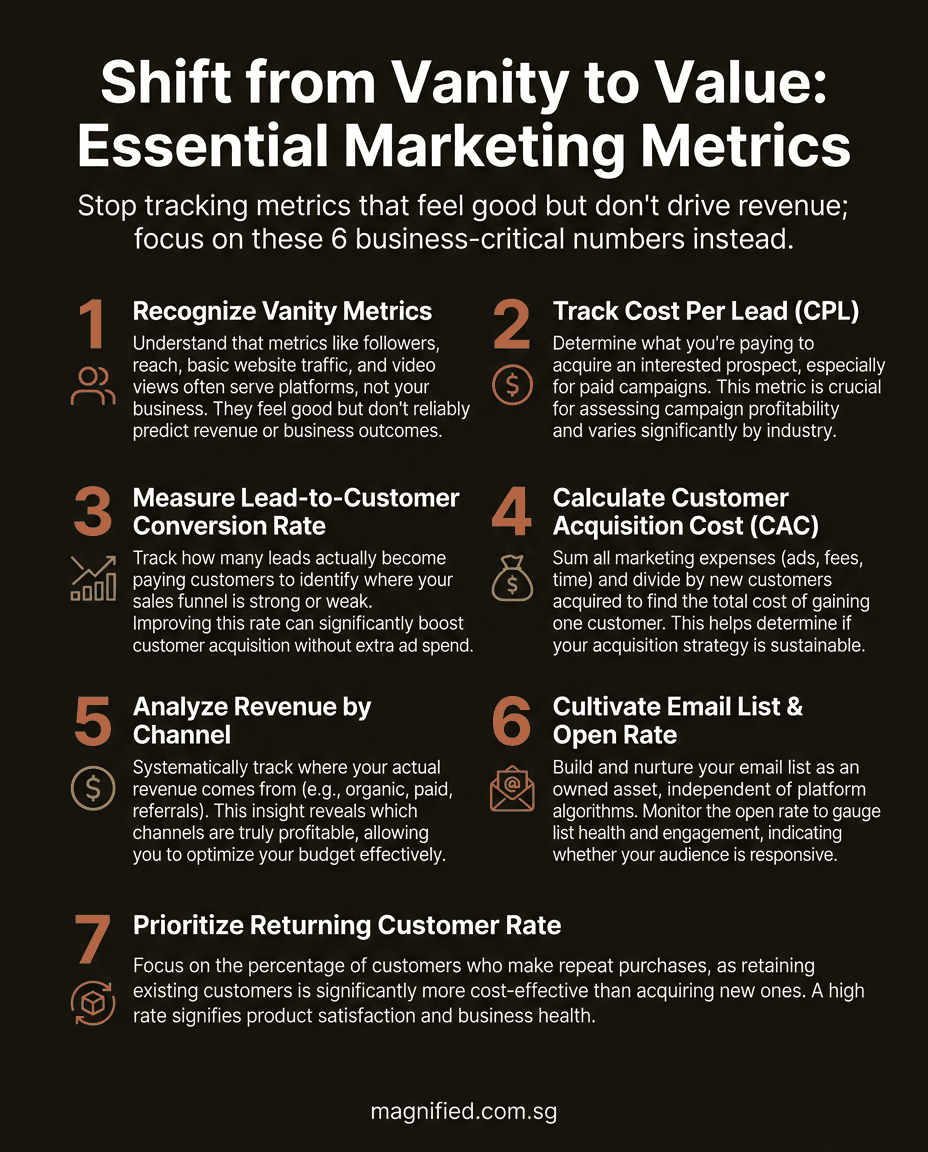
These are the numbers that connect directly to business results.
1. Cost Per Lead (CPL)
If you're running paid ads on Meta or Google, CPL is your most important campaign metric. It tells you what you're paying to get someone to raise their hand and say they're interested.
A CPL of $25 for a renovation company is excellent. A CPL of $180 for an $8,000 renovation project still makes sense. A CPL of $800 for a $1,200 product? You're losing money.
The benchmark varies by industry. What matters is tracking it consistently and knowing what your business can afford while staying profitable.
2. Lead-to-Customer Conversion Rate
This is where most SMEs lose track entirely. They count leads but forget to count how many leads actually became customers.
If your Facebook campaign brings in 100 leads per month and 5 turn into paying customers, your conversion rate is 5%. If you improve your follow-up and that rises to 8%, you've grown your customer base by 60% without spending a single extra dollar on ads.
Knowing this number also helps you identify where the real problem is. Low leads: a marketing problem. Lots of leads, few conversions: a sales or product problem. Two very different fixes.
3. Customer Acquisition Cost (CAC)
CAC is the total cost to acquire one paying customer. It includes ad spend, agency fees, your time, tools, everything.
Divide total marketing spend by the number of new customers acquired in the same period.
If you spent $5,000 last month and got 10 new customers, your CAC is $500. Whether that's sustainable depends entirely on your average order value and how often customers come back. Which brings us to the next metric.
4. Revenue by Channel
Where is your money actually coming from? Break it down: organic search, paid search, Meta ads, referrals, walk-ins, Instagram DMs, WhatsApp enquiries.
Most SMEs have a rough sense of this but don't track it systematically. Once you do, you often find that one or two channels generate the bulk of revenue while others quietly burn budget. Cut or scale accordingly.
This exercise alone has saved many businesses a lot of money. The answer is rarely what you expect.
5. Email List Size and Open Rate
Unlike social media followers, your email list is an asset you own. Platforms change their algorithms. They can also face regulatory challenges, lose popularity, or simply decide to demote your content. Your email list stays with you regardless.
List size matters, but open rate tells you whether the list is healthy. An average open rate of 20 to 30% for a B2B audience is solid. Consistently below 15%, your list is going stale and needs re-engagement or a cleanup.
If you don't have an email list yet, that's where to start. Not another social media account.
6. Returning Customer Rate
The percentage of customers who buy from you more than once.
Acquiring a new customer costs significantly more than keeping an existing one. Industry research consistently puts the ratio somewhere between 5 and 7 times more expensive, though it varies considerably by sector. (Retain a restaurant customer vs. a law firm client: very different dynamics.) In Singapore's SME context, where customer acquisition costs on Meta and Google have been rising steadily, your retention rate is one of the most valuable numbers in your business.
A healthy returning customer rate also tells you something the algorithms can't: people actually liked what they got.
A Simple Monthly Marketing Scorecard
You don't need a fancy BI tool. A Google Sheet works perfectly.
| Metric | This Month | Last Month | Target |
|---|---|---|---|
| Cost Per Lead (CPL) | |||
| Total Leads Generated | |||
| Lead-to-Customer Rate | |||
| New Customers | |||
| Customer Acquisition Cost | |||
| Revenue by Channel | |||
| Email List Size | |||
| Email Open Rate | |||
| Returning Customer Rate |
Fill this in at the end of every month. It takes about 20 minutes. After three to four months, patterns emerge: which channels are producing, where the funnel is leaking, where to double down.
One practical note: tracking CPL and conversion rates requires some setup in your ad accounts. Meta Ads has a conversion tracking pixel. Google Ads has a similar system. If you're running paid campaigns and these aren't configured, that's the first thing to fix — it's step one in any Google Ads management engagement worth paying for. Without conversion tracking, you're flying blind.
Why Most SMEs Skip This
Vanity metrics are easy. Your social media scheduler shows you reach automatically. Your ad dashboard puts impressions in a big number at the top of the screen. Someone designed the interface to make you feel good about being there.
The metrics that matter require more effort. You need to track leads from multiple sources: form submissions, WhatsApp messages, Instagram DMs, phone calls. You need to connect those leads to actual sales. You need to attribute revenue back to the original channel.
In Singapore's typical SME buying journey, this is genuinely complicated. Someone might discover you on Instagram, search for you on Google to verify you're legit, check your Google Business reviews, then WhatsApp to enquire. Attributing that sale to one channel precisely is difficult.
But you don't need a perfect attribution model. You need to be meaningfully better than "we post stuff and hope for the best." Even rough tracking like consistently asking every new customer how they found you is more useful than obsessing over your engagement rate.
One More Thing About Reach
This isn't an argument to ignore reach or followers entirely. For certain businesses (food and beverage, retail, events, anything where brand familiarity drives decisions), reach genuinely matters. If people see your name consistently, they're more likely to trust you when the moment to buy arrives.
The point is context. "We want to be the most recognised dental clinic in Jurong" is a legitimate goal, and reach is relevant to that strategy. "Our reach is up 40%, so our marketing is working" is a different claim and a much harder one to justify without more data.
Track what you're actually trying to achieve. Not what the platform happens to show you by default.
Ready to build a marketing strategy around numbers that actually move your business? Magnified helps businesses connect digital marketing to real outcomes, not vanity dashboards. Talk to us about your marketing goals.
Work With Magnified
Ready to turn traffic into leads?
We help SMEs grow with AI-powered SEO, content marketing, and paid ads. If you're getting traffic but not leads — let's fix that.