
Your Website Speaks HTML. AI Reads Markdown. Here's Why That Gap Matters.
Cloudflare's Markdown for Agents serves clean content to AI bots instead of noisy HTML. Here's what it means for your AI search visibility.
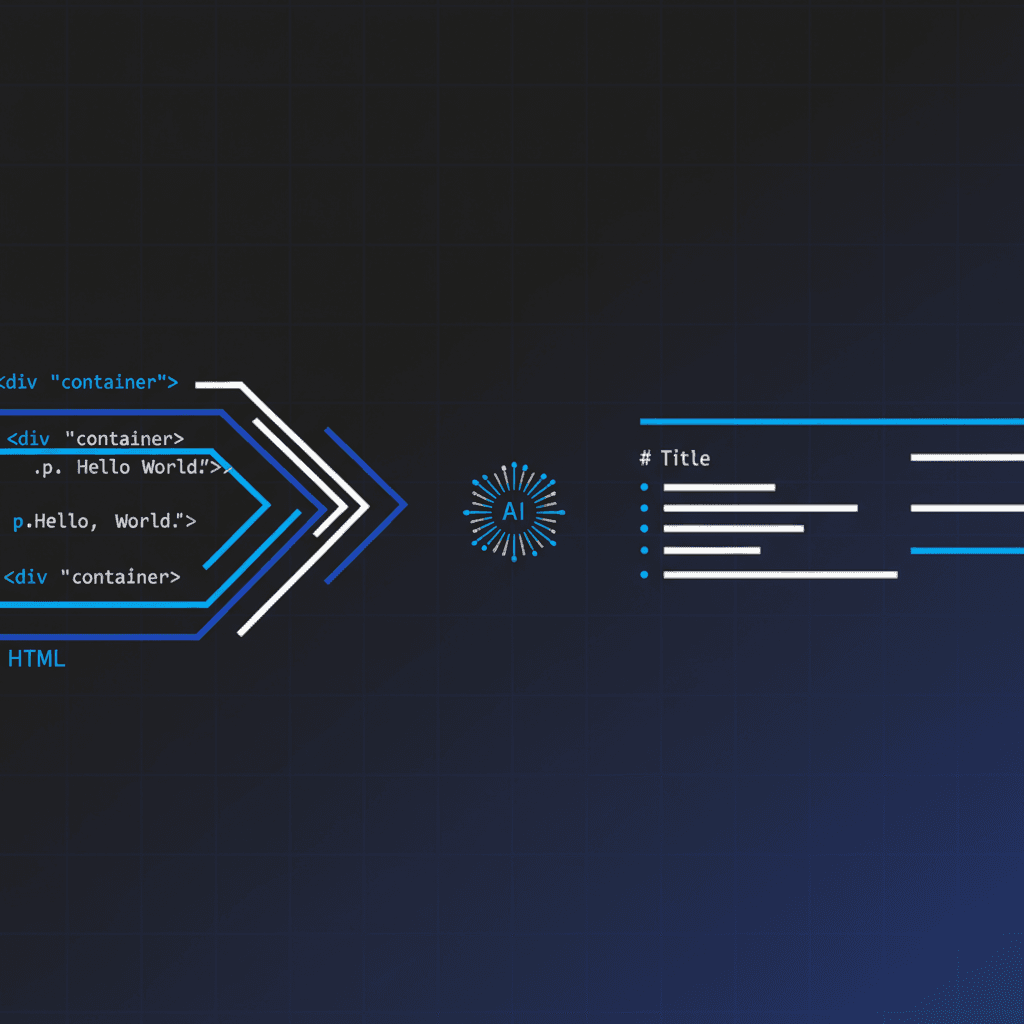
Picture this. A potential customer asks ChatGPT which accounting software is best for their business. ChatGPT visits dozens of websites, including yours. But when it hits your site, it sees a wall of navigation menus, cookie banners, sidebar widgets, and promotional popups. Somewhere in the middle is your actual content.
ChatGPT does its best. But the noise makes it harder to extract the useful bits.
That's the problem Cloudflare's "Markdown for Agents" feature is designed to solve.
Written by Derek Chua, digital marketing consultant and founder of Magnified Technologies. Derek works with SMEs across Singapore on technical SEO, GEO strategy, and AI search readiness.
Key Takeaway: Cloudflare's Markdown for Agents automatically converts your HTML pages into clean, structured Markdown when AI bots crawl your site, reducing token noise by up to 80% and making it significantly easier for AI systems to extract and cite your content. For sites already on Cloudflare, this is a low-effort infrastructure win. But clean content structure matters more than the delivery layer.
What Is Cloudflare Markdown for Agents?
Cloudflare published this feature in February 2026. The problem it solves is straightforward: modern websites are built for human browsers, not AI crawlers. A typical web page that takes 16,000 tokens to process as raw HTML contains roughly 3,000 tokens of actual content in Markdown. That is an 80% reduction in token noise.
When AI bots (ClaudeBot, GPTBot, Perplexity, and others) crawl your website, they are trying to read your pages. But your HTML is full of navigation menus, tracking scripts, image carousels, and structural elements that have zero relevance to the actual content. Cloudflare's Markdown for Agents feature automatically converts your HTML into clean Markdown when AI crawlers request it.
Instead of fighting through the noise, AI crawlers get a stripped-down, structured version of your page: just the headings, paragraphs, lists, and links that matter.
Think of it as a clean briefing document rather than a cluttered brochure.
For websites already on Cloudflare (which powers roughly 20% of the web), this can be enabled without touching your source code. For everyone else, the underlying principle is still highly relevant.
Why AI Bots Struggle with Standard HTML
HTML is designed to render in browsers. It is full of:
- Navigation bars and footer menus (repeated on every page)
- Cookie consent banners
- Social media sharing widgets
- Promotional banners and pop-ups
- JavaScript rendering that many bots cannot execute
- Nested div structures that bury content several layers deep
When ClaudeBot or GPTBot visits your site, it is trying to extract the meaningful content from all of that. Sometimes it does a reasonable job. Often it extracts the wrong thing, misses key content, or gives up entirely because the page is too JavaScript-heavy to parse.
Markdown for Agents sidesteps this. When an AI bot identifies itself in the request headers, Cloudflare serves a clean Markdown version instead of the full HTML. The bot gets your content in the format it can actually use.
How to Check if Your Site Is on Cloudflare
Before anything else: is this feature even available to you?
Check your DNS settings. If your domain uses Cloudflare nameservers (typically something like xxx.ns.cloudflare.com), your site is on Cloudflare. If you are unsure, ask your web developer, or look at your hosting account dashboard.
Cloudflare powers a significant portion of websites globally. Many SMEs are already on it for its CDN, security, and performance features, sometimes without realising it. If you are on Cloudflare, Markdown for Agents may already be active on your plan or available as an opt-in.
The Connection to GEO (Generative Engine Optimisation)
If you have been following Magnified's AI search coverage, you will know we have written extensively about GEO: optimising your content so AI systems can find, understand, and cite it.
Most GEO advice focuses on what you write. Markdown for Agents addresses how it is delivered.
There is an analogy here to Core Web Vitals. Google's page speed signals are not really about speed for its own sake. They are about whether Google can trust that your pages will load properly for users. Similarly, how cleanly your content is structured for AI consumption affects whether those systems can reliably extract and cite what you have written.
At Magnified, when we audit client sites for AI search readiness, the most common problem we find is not missing content. It is JavaScript-heavy pages where AI bots simply cannot read the text that exists. Content buried in dynamic carousels, tabbed sections, or React-rendered components often shows up blank to crawlers. Markdown for Agents does not fix that underlying issue, but it does significantly reduce the noise for everything that is already readable.
Does This Apply to You?
Here is the practical question: is this something your business needs to act on right now?
Probably not urgently. But it is worth understanding where this is heading.
If your website is already on Cloudflare, you can potentially enable this at the CDN level with minimal effort. The exact configuration depends on your Cloudflare plan and site setup. Check your Cloudflare dashboard or ask your developer.
If you are not on Cloudflare, the principles still apply:
Clean content structure matters. The best way to make your content readable for AI bots is also the best way to make it readable for humans: clear headings, short paragraphs, no jargon without explanation, and a logical flow.
Server-side rendering helps. If your website is heavily JavaScript-dependent, key content might not be visible to bots that do not execute JavaScript. This affects traditional SEO too, but it matters more as AI crawlers become important traffic drivers.
llms.txt is worth knowing about. Alongside tools like Markdown for Agents, there is a growing convention of websites publishing an llms.txt file in their root directory. Think of it as a robots.txt for LLMs: a structured summary of what your site is, what it offers, and which pages are most relevant. It is not yet a universal standard, but early adopters are already seeing it referenced in AI responses.
What This Actually Means for Your Marketing Strategy
Let me be direct about the ROI question here.
If you are an SME spending most of your marketing budget on Google Ads and basic SEO, Cloudflare Markdown for Agents is not where you should spend your next hour. The fundamentals matter more: clear content, good technical SEO, E-E-A-T signals, and local search presence will do far more for your AI visibility in the short term.
But if you have a website that is already technically sound and you are thinking about competitive advantage in the AI search landscape over the next two to three years, this is the kind of infrastructure decision worth getting right early.
The brands that are cited regularly in AI responses a few years from now will not necessarily be the ones that adopted Markdown for Agents first. But they will be the ones that built content worth citing, delivered it in formats AI systems can actually parse, and established enough topical authority that AI models learned to trust them.
Markdown for Agents is one piece of that infrastructure. It is not a shortcut. It is more like making sure your foundation is solid before you build upward.
What to Do Now
If you want to get ahead of this, here is a sensible sequence:
-
Audit your content for AI readability. Does your most important content (service descriptions, FAQs, case studies, how-to guides) exist as real text on the page? Or is it buried in JavaScript, iframes, or PDFs that bots cannot read?
-
Fix the structure before worrying about the delivery layer. Clean headings (H1, H2, H3 hierarchy), short paragraphs, and logical content flow matter more than any CDN feature.
-
Check if your site is on Cloudflare. If yes, ask your developer about Markdown for Agents. It may already be available on your plan. If so, enabling it is low effort with potential upside.
-
Consider an llms.txt file. If your business has complex services or multiple product lines, a well-structured
llms.txtgives AI systems a shortcut to understanding what you do. -
Focus the majority of your energy on content depth. The AI systems deciding which brands to cite are doing so based on the quality and trustworthiness of the content, not just whether it was delivered as clean HTML or Markdown. Great content in clean format beats mediocre content in perfect format every time.
The gap between what most websites serve (HTML built for browsers) and what AI systems prefer (clean, structured, parseable content) is closing. The tools like Cloudflare's Markdown for Agents are making it easier to bridge that gap. But the underlying principle is the same one that has always driven good digital marketing: make it easy for your audience to get value from what you have created, whether that audience is a human, a search engine, or an AI assistant answering questions on someone else's behalf.
Frequently Asked Questions
What is Cloudflare Markdown for Agents and how does it work? Cloudflare's Markdown for Agents is a feature that automatically converts HTML pages on Cloudflare-hosted websites into clean Markdown when AI bots request them. When a crawler like ClaudeBot or GPTBot sends a request, Cloudflare detects the AI user-agent and returns a stripped-down Markdown version of the page rather than the full HTML. This reduces token noise by up to 80% and makes it significantly easier for AI systems to extract and understand your content.
Does my website need to be on Cloudflare to benefit from AI-readable content? No. The underlying principle applies to any website: clear headings, short paragraphs, real text rather than JavaScript-rendered content, and logical structure all make your pages more readable for AI crawlers. Cloudflare's Markdown for Agents is a convenient way to automate the conversion if you are already on their network. If you are not, the same goal can be achieved through good content structure and server-side rendering.
What is llms.txt and should I add one to my site?
An llms.txt file is placed in your website's root directory (similar to robots.txt) and provides AI systems with a structured overview of your site: what your business does, what pages are most relevant, and how to navigate your content. It is not yet a universal standard, but it is a low-effort way to give AI crawlers a helpful map of your site. For SMEs with multiple services or product lines, it is worth considering.
How do I know if AI bots can currently read my website? A rough test: view your key pages with JavaScript disabled in your browser (usually in Developer Tools). If the main content disappears or loads incorrectly, AI bots that do not execute JavaScript will face the same problem. For a more thorough audit, you can check Google Search Console for crawl errors, review your server logs for AI bot traffic, or ask your digital marketing agency to run an AI readability check.
Is Cloudflare Markdown for Agents relevant for small Singapore businesses? If you are a small business still establishing basic digital presence, focus on fundamentals first: Google Business Profile, core service pages with clear text, and basic SEO. Markdown for Agents is an infrastructure layer for businesses that have already addressed the basics and are actively building AI search authority. If you are on Cloudflare already, it is worth exploring. If not, it is a consideration for future infrastructure planning rather than an immediate priority.
Magnified helps SMEs build digital presence that works across traditional search, AI search, and social platforms. If you are not sure how AI systems are reading your website, let's talk.
Free Audit
Not sure where your digital marketing stands?
We'll review your SEO, ads, and content — and tell you exactly what's holding you back. No fluff, no obligation.
Get a Free AuditWork With Magnified
Ready to turn traffic into leads?
We help SMEs grow with AI-powered SEO, content marketing, and paid ads. If you're getting traffic but not leads — let's fix that.